The 'V-shaped' agri-voltaic, an Italian experiment imitating nature
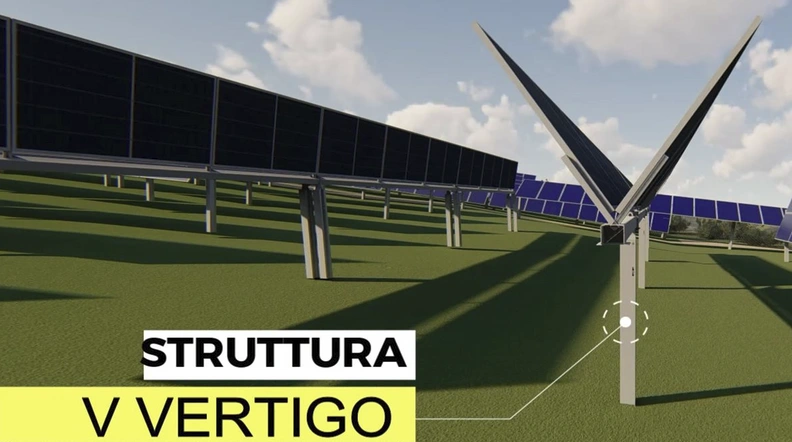
A configuration with bifacial photovoltaic modules mounted in a V shape, inspired by the sprouts of many plants. An Italian startup and the Department of Engineering at the University of Palermo are working on it. Advantages and complexities of the solution.
In the coming years, several gigawatts of agrivoltaic systems are expected to be installed in Italy. However, to qualify for incentives that offset their higher costs, these systems must meet strict requirements.
They must, above all, not occupy more than 30% of the total area, have modules mounted high enough to allow passage of agricultural machinery and livestock, and enable continued agricultural production without excessive crop shading.
These requirements reduce the overall productivity of an agrivoltaic system compared to a standard ground-mounted solar plant, while increasing costs for the support structures (in some cases installed up to 4 meters high). The control of tracking systems following the sun also becomes more complex
To address this challenge, two main types of agrivoltaic systems are emerging
The first type uses fixed vertical bifacial panels arranged in north–south rows. These systems are cheaper, take up little space, cast minimal shade, and provide a longer daily production curve— higher output in the morning and late afternoon (advantageous for selling electricity at better prices). However, at southern latitudes, where the sun rises higher, their yield is lower than in Central and Northern Europe.
The second type uses north–south single-axis trackers that follow the sun from east to west with two rows of panels, generating roughly 25–30% more power than fixed modules. These installations must be elevated and spaced out to avoid interfering with crops.
Engineer Christian Chiaruzzi, founder of the startup Horizonfirm srl, which specializes in photovoltaic installations, has designed and patented a concept that combines the benefits of tracking systems and vertical panels, adapting the latter to the sunlight typical of southern latitudes.
“We want to build a solar system for agrivoltaics using bifacial panels mounted in a V-shape, with the vertex supported by a north–south tracker similar to conventional ones, but with panels arranged in a line,” explains Chiaruzzi. “The two arms of the V can move independently, opening and closing between roughly 35° and 90°.”
The idea came to Chiaruzzi from observing how many plant sprouts have two leaves arranged in a V, capable of photosynthesis on both sides and of adjusting their orientation according to the sun’s position.
“Since nature optimizes structural efficiency through millions of years of selection, I thought imitating it in an agrivoltaic solar plant could bring significant advantages” he says.
Among these advantages: V-shaped panels obstruct agricultural machinery less, eliminating the need for high mounting—two meters of clearance is sufficient. This configuration also reduces ground shading by about 50% compared to horizontal panels, allowing for more rows in the field without reducing agricultural output.
The challenge lies in managing the inclination of the two independent panels throughout the day, finding a balance between maximizing solar output (which requires full exposure) and maintaining agricultural productivity (which requires limiting shading).
“Additionally,” notes Chiaruzzi, “the V configuration introduces another complexity: panels often reflect light onto each other, making it harder to calculate the ideal angle between them.”
This complex optimization was addressed by Professor Valerio Lo Brano and Engineer Stefania Guarino from the University of Palermo.
“We developed a mathematical model using the Python programming language, which offers powerful tools for research calculations,” explains Lo Brano, who published the results in Applied Energy under the title ‘Modelling and analysis of V-shaped bifacial PV systems for agrivoltaic applications: A Python-based approach for energy optimization”.
“It was a very challenging task,” Lo Brano continues, “because of the infinite possible positions of the two panels, the infinite solar positions, the complex mutual shading and illumination of the four panel surfaces, the internal reflections within the V, and the need to minimize ground shading. Eventually, we succeeded, creating an innovative and versatile tool for evaluating photovoltaic system performance and control algorithms.”
According to the model, a V-pair of 665 W bifacial panels can generate 2,089.3 kWh/year at Palermo’s latitude—about 15% less than a conventional single-axis tracker, but with 50% less ground shading.
“This result also comes from the fact that the V-shape better exploits the bifacial effect, exposing the rear sides more,” adds Guarino. “Since bifacial panels generate nearly equal energy on both sides and cost almost the same as monofacial ones, our configuration fully leverages their potential.”
The Palermo team’s work is only a first step. Lo Brano explains:
“We analyzed only the configuration called Vertigo, in which the V always points upward, with variable opening angles. But there is also the Butterfly configuration, where the V follows the sun’s path throughout the day, adjusting the panel opening in each row to avoid shading the next one. It is theoretically more productive but also more complex to model. That will be the subject of our next publication.”
Meanwhile, Chiaruzzi is already preparing a field test.
“In collaboration with Trina Solar and Huawei, we’ll start building a 1 MW agrivoltaic plant near Piazza Armerina this summer. Alongside conventional tracker rows, we’ll install two rows of Vpanel trackers to test different control algorithms and compare their performance directly” says the startup founder.
The plant is expected to start generating power by autumn, revealing whether this Italian innovation can indeed combine the advantages of tracking and vertical solar designs.
A question remains: won’t independently moving the two arms of each V double the cost of the tracking mechanism and increase maintenance compared to a conventional single-axis tracker?
“That’s true,” admits Chiaruzzi, “but we’re confident that using less structural material—since our systems are lower—and achieving better agricultural integration thanks to reduced shading will more than offset that disadvantage. In any case, within a few months, we’ll have concrete production data from the V-shaped agrivoltaic system."
Sources cited in the PDF:
© QualEnergia.it – Reproduction of the article is prohibited without authorization from the editorial staff (redazione-online@qualenergia.it ).
Date / 6 November 2025
More stories of
renewable energy